The DogVenture Begins!

 Here it is, May 3rd, and the world is wondering if I really haven’t been anywhere since March 19th and my last post. After all, what kind of dilettante stays home? But, the truth is that four foreign countries on three continents in three months was a lot even for me. Don’t get me wrong; I enjoyed it. But it is, alas, an unsustainable lifestyle.
 All this to say that I did go somewhere in April, to Orcas Island again, for two nights with several friends, and Ian and I attended our second West Sound community meeting—this one the monthly potluck (living off-island, I brought cookies).
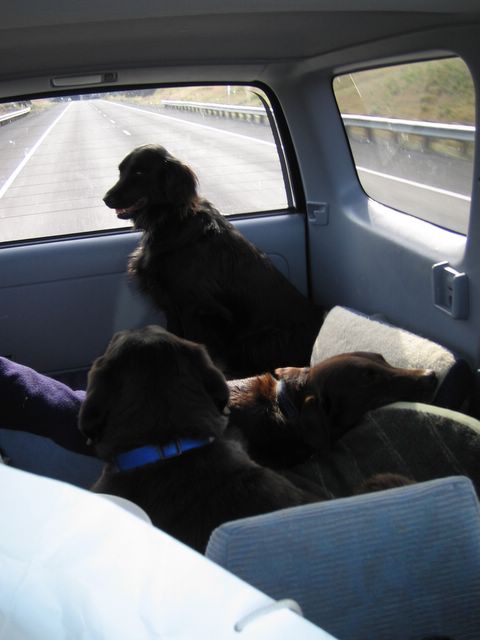
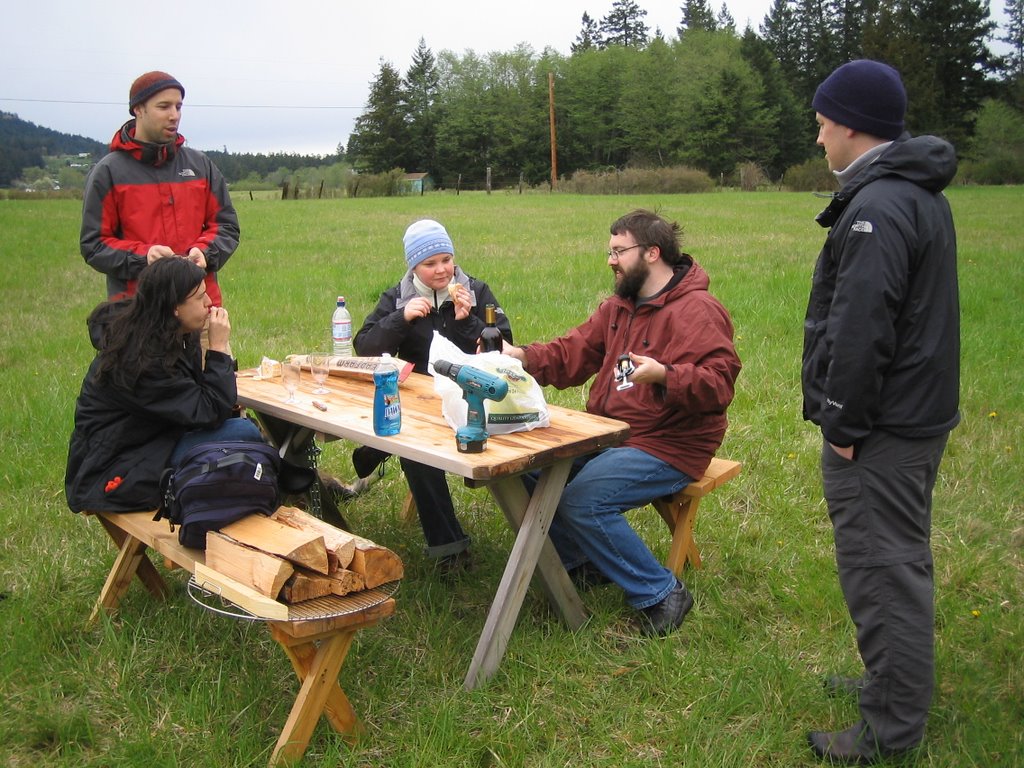
We stayed, six of us with two dogs, at the North Beach Inn, which is really a fantastic place. The 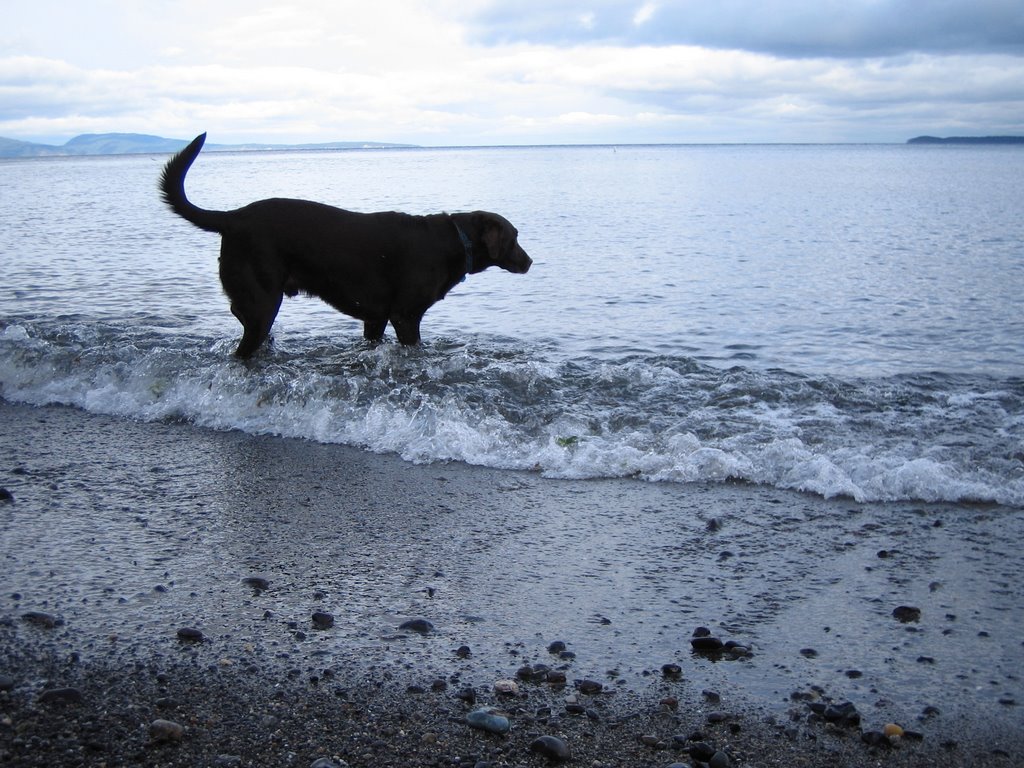
The weather was more or less clear while we were there, so we took long walks along the beach both during the day, looking out to Sucia and Matia islands and wishing we could paddle over to them, and during the night, looking north to the lights of
On Saturday evening, Ian and I left the other four (two of whom were heading back to the mainland), parked our car and dog at our property, and proceeded to meet another subset of the disproportionately elderly population of this world we’re planning to move into.
The West Sound Community Potluck is an ancient tradition, as ancient as just about anything on the island and, indeed, in the state. It’s been going on now for 100 years, second Saturday of every month minus June, July and August, and most attendees looked like they were probably charter members. Not everyone who lives in the community comes every week, and some people never come. But this particular week, we were going to be treated to a presentation about local disaster readiness (“NEITHER WASHINGTON STATE NOR FEMA NOR THE NATIONAL GUARD WILL BE COMING TO HELP US. THE RED CROSS, THE WORLD BANK, THE FBI AND THE CIA HAVE NO EMERGENCY PLANS FOR WEST SOUND”) and the evacuation plan (which, after 30 minutes, came to “In case of wildfire, run toward the water. In case of tsunami, run toward the hills.” No discussion of what would happen to us in the case of a conjunction of the two.), so the attendance was perhaps a bit better than usual.
The potluck fare was not disappointing. Traditional dishes such as turkey casserole, Mexican hot dish, and macaroni salad were readily available, but so was octopus, caught earlier that day by one of the attendees and served steamed, cut into three-cup (that’s suction) chunks, with a dipping sauce.
As people licked the last drips of pie and ice cream and/or gingersnap cookies off their spoons, the presentation began. It seems that the evacuation plan was designed the previous year, by the presenter (the elderly French gentleman from the earlier meeting) and one of our neighbors, who used to fly a forest fire-fighting plane (until the fleet was grounded because too many planes—WWII era—were going down in flames, kind of defeating the purpose) and so presumably has some training in evacuation. A phone tree had been drawn up to make sure everyone was notified of last year’s practice evacuation (which sent everyone to the Community Hall, a 100-year-old wood building on the waterfront that would be, in fact, the worst of all worlds in an actual emergency, but there are glasses and plates there for serving the champagne and dessert purchased to reward people for participating.). The phone tree had not worked, however, and here is where “presentation” degenerated into “free-for-all”, everyone shouting suggestions of how to make the phone tree work better, since leaving messages for people didn’t seem to be the answer.
Now, I don’t know about you all, but my understanding of a phone tree was that you call the next person on the list and you’re done—unless the next person is gone, in which case you call the person he or she was supposed to call. In other words, you talk to an actual person and don’t trust that Joe, as the tsunami approaches, is going to be checking his messages, and then making some calls. I mean, maybe Joe saw the wave and hightailed it out of there.
This practice is not, however, as self-evident as it would appear. No, to make sure everyone gets a call, the community is going to have not one, but two phone trees in differing shapes. Sure, some people might get two calls, but that’s better than one, no? In an emergency? And, well, if two’s better than one, three would be even better. So yeah, as we left the phone-tree part of the conversation and moved on to the Warning Whistle, plans were being made to draw up three varying phone trees, all calling the same people but in different orders, to guarantee that everyone’s stuck at home while waves wash around their ankles or their houses incinerate around them.
The Warning Whistle hadn’t worked last year, either, because it turned out people couldn’t hear it from home (even people who lived fairly close to the Community Center and weren’t, necessarily, that hard of hearing). After a great deal of discussion about what, in fact, it sounded like and plans to blow it later in the month at the next scheduled evacuation practice, a member jumped up from his table and said “Well, can’t we just blow it now?”
French Man dithered a bit, but couldn’t, ultimately, see why not. It was only about
Soon after, the evening ended and Whistle 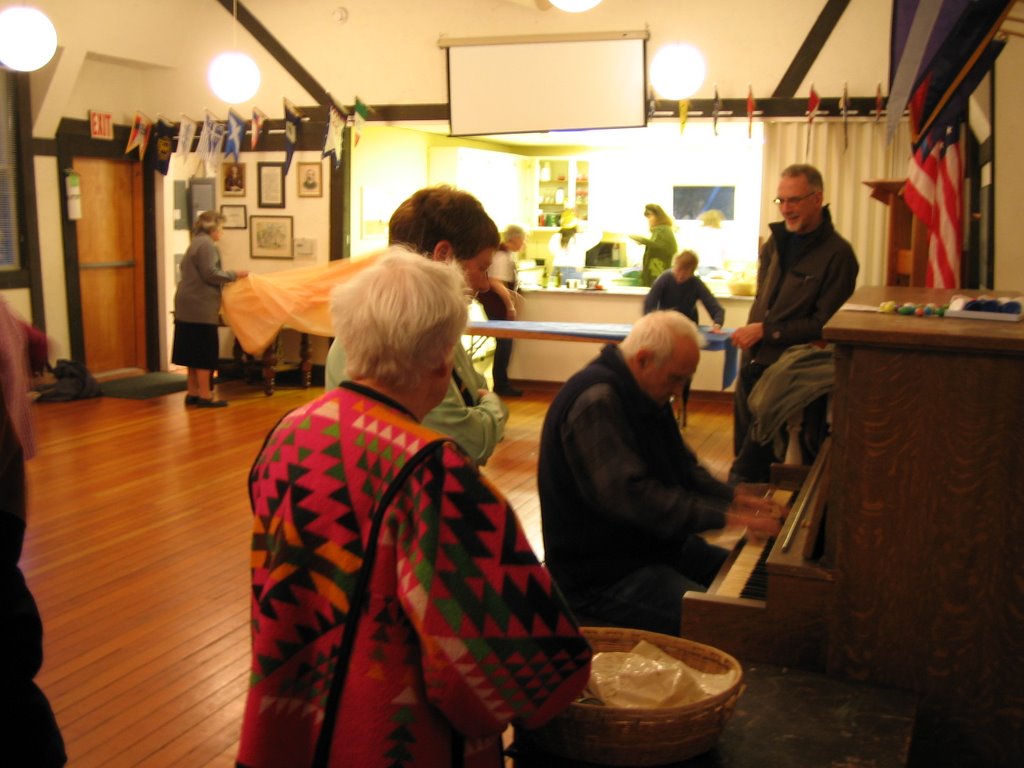 Blower played some rousing numbers on the out of tune spinet as volunteers broke down the tables and stacked the chairs.
And we went off to town, to play pool and drink Jack and Sevens at Vern’s Bayside Café with our friends, and marvel at our incredible good fortune, that this is where we’re going to get to live out our lives.
 Ian and I arrived home last night around 6:15 pm, almost nine hours after leaving Sun Peaks, and 30 minutes after dropping D&E off, five miles from our house. Yeah, the traffic crawling toward downtown on a Saturday evening after a day of driving through snow, sleet and sun is not what I love.
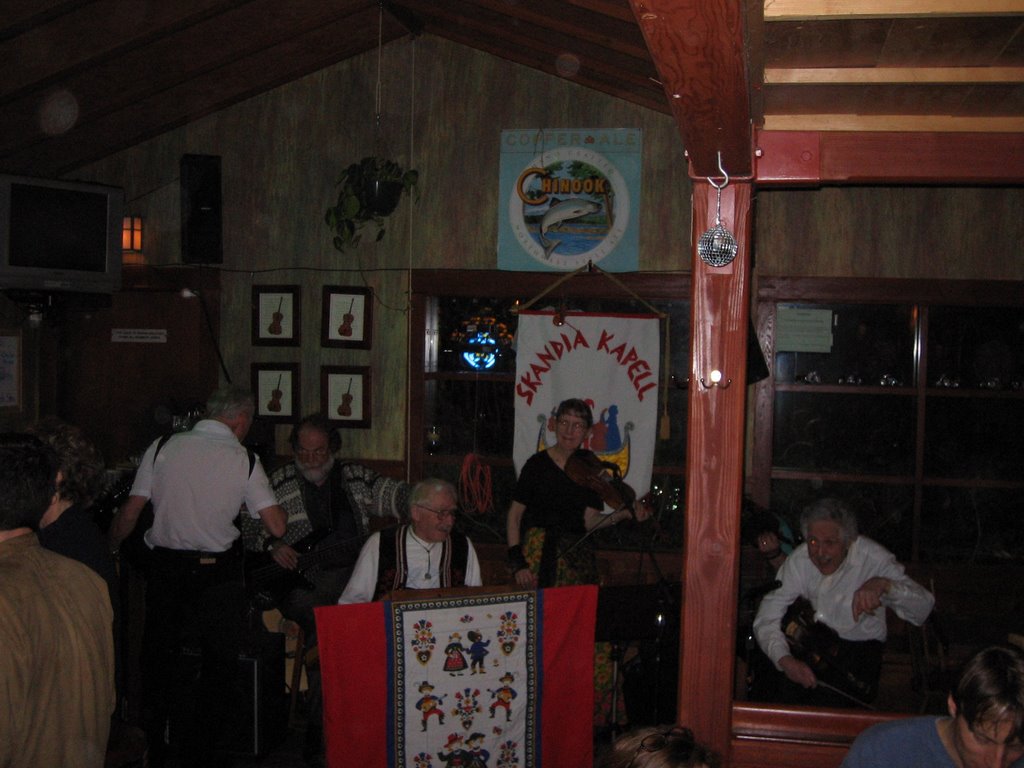
 What I love is this: S finished her master’s thesis yesterday and sent it off, so she and Intrepid Aunt L (S’s mother, if you’ll remember) and S’s husband, C, invited us to join them at the Fiddler’s Inn, a pub near their house, for a celebratory pint and dinner. A notice on the door informed customers of a $3 cover charge from 9:00 pm to midnight, as there would be live music. As 9:00 pm approached, people with violin—or, excuse me, fiddle—cases started arriving and a space was cleared near the bar. Someone else pulled out an accordion, much to Ian’s delight, and the band broke into song. Now, fiddle and accordion music makes for a rockin’ good time no matter what, but this was even better because—and I kid you not—this band, Skandia Kapell, has been around since 1957, and two of the fiddlers were original members. Yes, that’s right—the entertainment at the local pub on Saturday night from 9:00 pm to midnight was a band of 80-somethings. And I tell you—when a little old man asks you to stand up and do the chicken dance in a bar, to live music played by his contemporaries, you do it.

Commentary
I do actually read the comments to my blog, which reminded me to add a bit more information about the dog-and-accordion busking I saw in Lisbon, and while I’m at it, I’ll throw in the quick tutorial on port, which I promised but didn’t deliver.
First of all, street performers are not uncommon in the touristy parts of
Port, a wine fortified by a grape spirit distilled from the same grapes as the wine, is much more complex and varied than the tawny, vintage, occasion ruby, and very occasional white styles we get here, including styles like lagrima (sweet white), colheita (single harvest but not a vintage), late-bottled vintage (aged in wood and bottled after it’s aged, like a tawny), and many more I can’t remember off hand, so I’ll focus on the ones we’re likely to get in stores here.
Vintage: This is a fruity port, which ages in the bottle. Store it in a cellar, if possible. Vintage ports are not made every year; only on particularly good years. Once a decade or so every port grape grower universally declares a vintage; usually, however, one grower will have a particularly good year and another won’t. A vintage port should be stored for at least 10 years, but can be stored much longer. 1994 was a universally good year; I have a bottle of that vintage in my cellar which I believe I bought for about $30 in 1998. It’s now sold for about $120. To serve a vintage, 24 hours before opening, stand it upright so the sediment can fall to the bottom (all wines should be stored on their sides to keep the corks wet). Open, decant into a carafe, and drink. Since vintage ports have had little exposure to air (being aged in glass), they are delicate and oxidize quickly. Once opened, a vintage port should be drunk within 4 days. This is usually not a problem for people.
Ruby and Tawny: These are basically the same. Both are aged in wood, and blended by tasters so that the character of each remains the same year after year. The main difference is that ruby is aged no more than about 3 years before it’s bottled, whereas tawny is aged up to 40 years in oak. The names refer to the color: since ruby is only in wood about 3 years, its deep red color hasn’t leached into the oak barrels. Tawny, however, gets paler, tawnier, with age. Ruby and tawny ports are not delicate and can be enjoyed for up to a year after the bottle is opened.
White: Dry white port is an aperitif instead of a digestif like the rest of the ports; it’s a little like sherry in that way. Serve this port (but only this port) chilled. Being white, it’s usually not aged (perhaps like the ruby, about three years tops). It does last a long time in the fridge, though.
My favorite cellar is Calém, which, yes, looks like my name, but is incredibly good and consistent nonetheless, producing rich, fruity ports that somehow manage to avoid being syrupy. Other good names are Ferreira, Taylor-Fladgate, and Ramos Pinto. I tend to avoid Fonseca and particularly Sandeman, which seem to have better marketers than wine-makers. Graham’s Otima 10 or 20 year in the clear bottle is drinkable, as well, and I admit I like how the bottle shows off the rich color.
And thus ends Europe.
Shameless plug for a fantastic winter resort
We visited Whistler the first year, and stayed in a ski in/ski out condotel for a week. This was pretty nice, but there were other places within driving distance. The next year we chose
The next year, we came to Sun Peaks. D had heard from a friend that it was a newly minted resort, and so not terribly crowded yet. My mother, hearing it was near
Sun Peaks lies about 7 hours from Seattle (although we’ve only once in three attempts so far made it here in anything approaching that little time . . . easy to get lost if you actively try, which we did the first two years, although we are familiar now with many back roads in rural Whatcom County, and many even backer, dirt roads, in whatever township it is around Kamloops). In the last three years even, development has exploded, with large, beautiful townhome vacation condos going in all over the valley. But they’re nice looking on the outside, all timber framed and full of windows to take advantage of the scenery, and fantastic on the inside. This year we’re staying in a two bedroom plus den (for accordion, horn, or computing), which shares a wall with a vacant place on one side and a place on the other side full of a family of five. Here’s the amazing thing—we really only know they’re a family of five because we’ve seen the kids in their hot tub. We hear them not at all, except when they’re going up or down the stairs, which they evidently can only do as fast as possible, but they also evidently only do rarely. Really, the soundproofness is amazing.
And outside, not only are there almost 3000 vertical feet and almost 3700 skiable acres for downhill, there are also 40 or more miles of cross-country skiing trails (with more than half track-set), and probably 15-20 miles of snowshoe trails which I can now say, without hesitation, is way more than enough.
We always get 4 of 5 day tickets so we can take a day off in the middle and recover our strength, and today was that day. Except for the three hours of snowshoeing (which is, in fact, more painful on the feet than skiing and way more tiring) and the 1 ½ hour return hiking on one of the graded cross-country trails. Yeah. Totally rested.
Of course, there are also such adventures offered as driving your own dogsled team, a fondue dinner and a torchlight ski down an easy hill after dark, sleigh rides and more.
But the true best thing about staying in an actual condo with an actual kitchen? Dinners like tonight’s—homemade mushroom risotto and weisswurst—or last night’s Indonesian tempeh with peanut sauce, or the upcoming halibut curry and mango sticky rice dessert, or the aforementioned nerd pizza.
Really, isn’t it always about the food?
You know you’re on vacation with a bunch of nerds when . . .
European Highlights
The Synergy of Music and Words
The impetus for the European vacation taking place in late winter was, as I said, to attend AC’s international debut, singing the soprano part in Osvaldo Golijov’s La Pasión según
Any Passion, of course, is telling the story of Christ’s last days and his annunciation. It’s a familiar story of despair and betrayal as well as hope and love, and it’s a story that has been set to music for centuries. The fact that Golijov is Jewish may make it seem as though he were not an appropriate choice to tell this very Christian story, but he recognizes the universals of humanity and emotion, and that’s what is needed.
The
The other section that made a deep impression on me was the choral piece telling of Christ’s walk to
A part of the story I had never really paid much attention to—the people lining the road on the way up to the hill—was suddenly, chillingly clear. It’s a sad story—I had always assumed that, overall, even the jeerers were a little sad. But no, this music made it abundantly clear—on a visceral, horrified, almost cellular level, that they were very likely having a great time.
And therein lies the amazing alchemy of lyric and note.
Life Tapestry
For me, the biggest thing I carry around all the time is the fact that I’ve had breast cancer twice now. The first time I was 26; I had a recurrence less than two years after finishing my chemo and radiation, when I was 28. I’ve been in remission since then, over four years since finishing chemo for the second time. My remission has been supported by a continuation of some therapies—I am currently in the clinic every three weeks for about three hours, receiving an infusion of Herceptin and a pellet that blocks ovarian function, plus I take a teeny pill every morning. Every three months, I also get a battery of blood tests and a dose of Pamidronate (which brings clinic time up to about six hours), either a chest X-ray or a chest CT, and I visit with my doctor. Once a year I have bilateral mammograms and breast and brain MRIs. This is not an insignificant amount of time, and it was, I believe, misguided of me to assume that the effects of these things on my travel would be insignificant. They are not.
For one thing, having to be at the clinic every three weeks places a sometimes inconvenient framework around my flexibility. I liken the three weeks to a bungee cord—I can stretch my limits a little for a short time—having an infusion two days late or one day early—but nevertheless I have to plan carefully, which frequently has me in the clinic either the day I take off for somewhere or the day after I get back; thus I’m combining jet lag with my day or two of chemical adjustment.
The greatest effect at the moment, though, is my fear of flying. In June, I have my last infusion. I will be set free from this onerous, tedious, exasperating existence—or maybe I will have my safety net removed and come crashing into the ground. I believe that my fear of flying is related to my cancer in two ways.
One, it’s a clear transference of my fear of death. There’s a limit to what I can do to keep from dying of cancer. I can eat well, I can exercise, I can be honest with myself about what makes me happy and try to lead an examined life. I can avail myself of resources outside my own personal control, such as medical experts, literature, support groups. But ultimately, the outcome will not be decided in any clear way by me. Thousands of people die of cancer every year. There are no guarantees.
I can, however, guarantee that I won’t die in a plane crash (this tragedy in
Two, flying is a transition, and transitions can be incredibly scary, particularly the one I’m entering now, winding down five years of chemically supported health and finding out if I can go it alone. Moreover, I have the habit of using foreign travel as an excuse to relax my standards for healthy eating and drinking—I have dessert or sweets regularly, I drink wine or beer or a cocktail (or some combination of all three) every night, I eat meats, cheeses, fats—in short, I allow the transition of flying to free me from habits I know to be reasonable, and usher me into a carefree lifestyle I crave but, deep down, fear.
My last 36 hours in
I see my life as a tapestry, and cancer, bile-yellow, is one of the threads. On its own, the color is jarring, blaring, nauseating. But woven in with the other threads, it creates a masterpiece. It throws the intense crimsons and plums of love into deep relief, adds an edge of fierce immediacy to the vivid, glinting goldenrods and platinums of joy, slides along subtly underscoring the periwinkles and indigos of peace and reflection. My life is infinitely the richer for it . . . but that doesn’t make the weaving easy.